
Overview
Garma Festival is one of Australia’s largest First Nations gatherings and is a four-day celebration of Yolŋu life and culture, held annually on Yolŋu Country in remote northeast Arnhem Land. Hosted by the Yothu Yindi Foundation, Garma is a nationally significant Aboriginal-led event that brings together clans and families of the region and showcases traditional miny’tji (art), manikay (song), bunggul (dance) and storytelling in a Yolŋu cultural setting.
Alongside its cultural program, Garma hosts a forum for dialogue on contemporary issues, featuring panel discussions and conversations between prominent First Nations leaders and non-Indigenous leaders from Government, business, academia and community. The Festival regularly attracts senior national leaders, including the Prime Minister, Minister for Indigenous Australians and the Ambassador for First Nations Peoples, and provides a unique platform where culture, policy, leadership and truth-telling intersect.
Australia Awards is committed to embedding First Nations perspectives, knowledges and leadership across the program and providing scholars with opportunities to deepen their understanding of First Nations cultures, histories and strengths, and to reflect on the relevance of Indigenous perspectives to their own countries and areas of study. Click here to know more about DFAT’s First Nations International Engagement Strategy.
Preparing for the experience
You are a part of a small group of seven Australia Awards scholars, who have been selected to attend the First Nations Cultural Immersion to Garma Festival. In total, we will be a group of 10, accompanied by the Australia Awards First Nations Advisor (Alice Tamang), the Australia Awards Communications and Public Diplomacy Manager (James Watson) and DFAT’s Assistant Director of Outreach, Australia Awards Section (Rosemary Welsh).
Attending Garma Festival is a unique and special experience. During the festival you will be immersed in a culturally grounded environment where traditional knowledge systems, cultural expression and contemporary dialogue intersect. The immersion will provide opportunities to engage directly with First Nations leaders, Elders, artists and community members, while observing cultural practices and engaging with nationally significant conversations on issues such as governance, reconciliation, policy, cultural preservation and self-determination.
The experience will deepen your understanding of First Nations peoples and perspectives, strengthen your cross-cultural capability and help you critically reflect on the relevance of Indigenous knowledge and leadership in both Australia and your home country.
As only a small group of Australia Awards scholars are attending, it is important that the impact and learnings from this cultural immersion extend beyond those directly attending. Scholars will be supported to participate in public diplomacy and knowledge-sharing activities, including reflective storytelling and a post-immersion event, to share learnings with fellow scholars and alumni. The format of the post-immersion event has not yet been defined, as it will be shaped by scholars attending. In the leadup to Garma, and during the festival, the Australia Awards encourage you to consider ways in which you can share your learnings and reflections for broader impact.
An online pre-departure briefing will be held on Thursday 16 July at 3:00pm (AEST). The briefing will provide practical information in relation travel and logistics, as well as what to expect onsite and how to get the most out of the experience. You will also meet the other scholars attending and have a chance to ask any questions.
Pre-reading materials
To support you to prepare for attending Garma Festival, and to ensure you get the most out of the experience scholars are asked to engage with the following materials.
Garma Festival Website
Please review the Garma Festival Website to familiarise yourself with the festival. In particular, the following sections of the website are important to review:
Garma Festival Program
The festival program is usually released a few weeks before the festival. The Australia Awards will share the program with you once released, and will recommend a mix of sessions to attend. During the festival you will also have unscheduled time, so you can choose sessions relating to your own academic or personal interest. To get an idea of what you can expect, you can review last year’s program.
Yothu Yindi Foundation
Garma festival is run by the Yothu Yindi Foundation is an Aboriginal organisation, established in 1990 to promote Yolŋu cultural development with community leaders and persons of authority from thirteen regional clan groups:
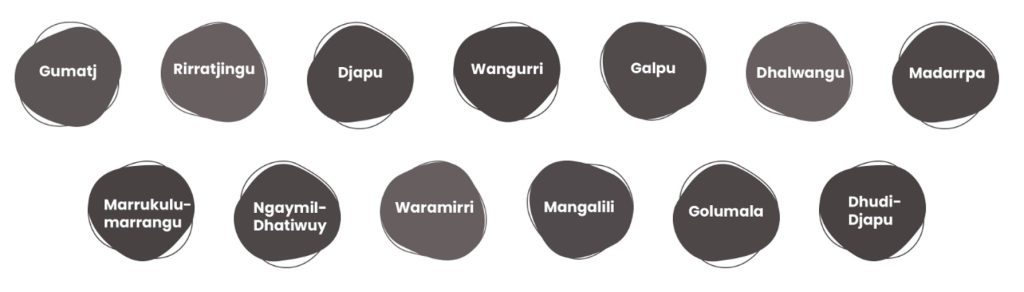
The mission of the Yothu Yindi Foundation is for Yolŋu and other Indigenous Australians to have the same level of well-being and life opportunities as non-Indigenous Australians. We encourage you to read about the Yothu Yindi Foundation on their website: https://yyf.com.au/
Yolŋu People and Culture
The Yolŋu People are made up of many interconnected Clan groups, each with their own identity, lands, cultural responsibilities and leadership. Yolŋu communities are located across north-east Arnhem Land, in the Northern Territory and many Yolŋu communities are located in extremely remote areas, where people live on their ancestral lands. Yolŋu people speak a number of related languages and dialects, collectively known as Yolŋu Matha, and continue to maintain their cultures, through strong connections to Country, kinship, ceremony, language and lore. Yolŋu culture is vibrant and strong, with many people continuing to live on and care for their ancestral Country, practise traditional ceremony, speak language and pass down cultural knowledge between generations. Approximately 5000 Yolŋu live in North-East Arnhem Land, from around 40 differing language groups.
The Yolŋu world is made up of two moieties, Yirritja and Dhuwa – two equal parts of a whole. All living things are classified as such, and are interconnected and must remain in balance. To learn more about this, you can read a transcript of an interview with respected Yolŋu linguist and teacher, the late Dr. R Marika.
All Yolŋu people are related through a sophisticated kinship system, known as Gurruṯu. “Gurruṯu relationships are reciprocal and they are taught from birth. You are born into the same moiety and bäpurru (clan group) as your father, and the opposite moiety to your mother. Gurruṯu relationships connect each person with their own bäpurru (clan and clan’s ancestors) through the paternal or male line of descent (yarraṯa), while through the female or maternal line (yindipulu), that person is connected with their mothers’ clan (ŋäṉḏipulu). Gurruṯu also directly informs all elements of Yolŋu social, political and legal governance including land tenure, ceremonial practice, as well as the roles and responsibilities of all people to each other in all contexts.”1
The Yolŋu have a history of international engagement. For hundreds of years prior to European colonisation, many Yolŋu communities had long-running trade connections with Macassan fishers, who would travel from Indonesia to fish for trepang (sea cucumber). During this time long-term trading and working relationships were developed, until the trade was banned by the Australian Government in 1907.
There is no single resource that can provide a complete understanding of Yolŋu people and culture and Yolŋu people and communities are incredibly diverse. The most meaningful learning will come through respectfully engaging with Yolŋu people, listening deeply and observing. Where appropriate, ask thoughtful questions and be open to different ways of knowing, being and doing.
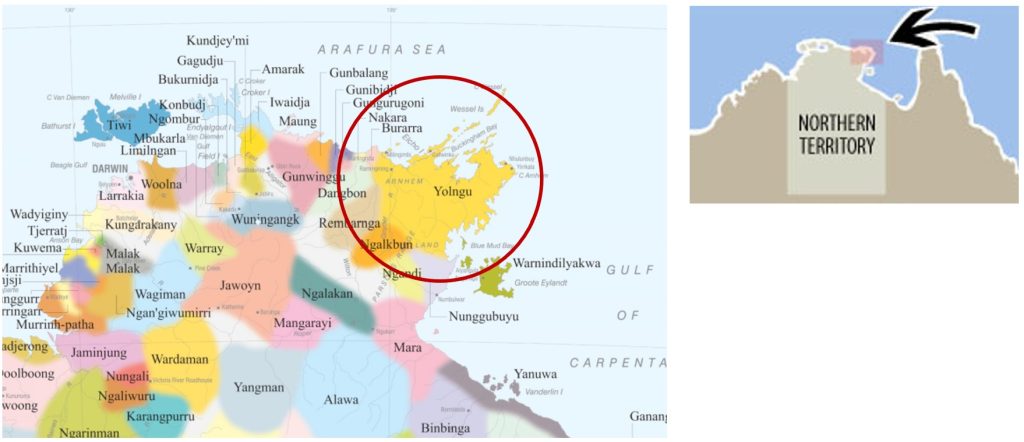
Garma Festival takes place on the Gulkula Ceremonial Site, on the lands of the Yolŋu People of the Gumatj Clan. Gulkula is located in north-east Arnhem Land in the Northern Territory, near the town of Nhulunbuy (formerly known as Gove) and the community of Yirrkala.
The Yolŋu Clan groups from the surrounding areas where Garma is held, are known for their strong activism. In 1952 large deposits of bauxite were found in Melville Bay, north of Yirrkala and mining operations by non-Indigenous people and companies began on Yolŋu lands soon after. The Yolŋu were not asked permission to mine on their lands, and in response led a strong campaign of activism to assert their rights and protect their Country – this included the presentation of the Yirrkala Bark Petitions to the Australian government in 1963.
To help you understand the significance and history of Yolŋu advocacy, we recommend you read this article about the history of the Yirrkala Bark Petitions: https://www.nma.gov.au/defining-moments/resources/yirrkala-bark-petitions
In the years since the Yirrkala Bark Petitions, countless Yolŋu leaders have advocated for change to improve the rights, well-being and life opportunities of Yolŋu people. While Garma Festival is a celebration of cultures, it is also a unique way that Yolŋu People continue their advocacy – bringing people together to build cultural understanding. The word Garma literally means ‘two-way learning’. The Key Forum at Garma is a significant opportunity for advocacy and has become Australia’s premier platform for the discussion and debate of issues affecting First Nations people, with panels and speeches covering a range of relevant policy topics. The Key Forum regularly features respected Yolŋu and First Nations leaders from across the country, as well as significant political leaders such as the Prime Minister and Minister for Indigenous Australians.
Common Yolŋu terms
Here are some common Yolŋu Matha terms you will likely hear at Garma Festival:
- Nhamirri nhe? (how are you?)
- Manymak (good)
- Yaka (no)
- Yaka manymak (not good)
- Buŋgul (dance, ceremony)
- Bukmak (everyone)
- Miyalk (woman, female)
- Ḏirramu (man, male)
- Bäyngu (no, nothing)
- Ma (okay)
- Gapu (water)
- Bäru (crocodile)
- Yidaki (Didgeridoo)
- Yothu Yindi (mother and child)
- Garma (two-way learning process)
- Balanda (non-Indigenous person)
- ARDS, Wundaŋarr Yolŋu Gurrutu Strong Yolŋu Families resource: https://studentwellbeinghub.edu.au/media/003jlunj/pdf-rre-strong-families-fv-resource.pdf ↩︎
